
Published on: Jan 30, 2026
Last modified on: Feb 26, 2026
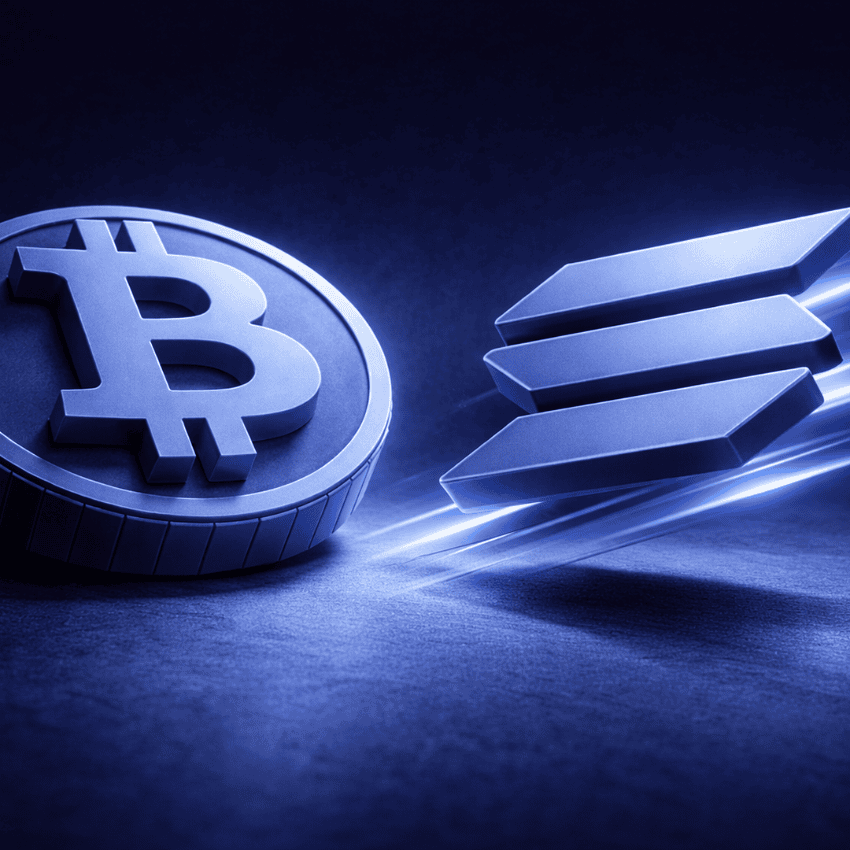
Bitcoin vs Solana: What’s the biggest difference between BTC and SOL?

Published on: Jan 30, 2026
Last modified on: Feb 26, 2026
At first glance, Bitcoin and Solana seem to compete in the same arena. Both are blockchains. Both move value. Both have massive communities and global recognition.
But comparing Bitcoin and Solana purely on speed or fees misses the point. These two networks were built for fundamentally different missions. The biggest difference between BTC and SOL isn’t technical — it’s philosophical. One prioritizes trust minimization and permanence. The other prioritizes performance and scale.
Bitcoin was created to be censorship-resistant money. Its core promise is simple but radical: no central authority, no permission, no single point of failure.
Bitcoin optimizes for:
security over speed
predictability over flexibility
stability over experimentation
Its code changes slowly by design. This conservatism isn’t a weakness — it’s the reason Bitcoin is trusted as a long-term store of value and settlement layer. Bitcoin isn’t trying to keep up with apps. It’s trying to remain reliable for decades.
Solana was built for a different era and a different problem. Its mission is to support consumer-scale applications on-chain — fast, cheap, and responsive enough to feel like modern software.
Solana optimizes for:
high throughput
low and predictable fees
real-time user experience
Instead of minimizing change, Solana embraces rapid iteration. It’s designed to evolve quickly, add features, and push performance boundaries. Where Bitcoin asks “Can this run forever?”, Solana asks “Can this run for millions of users today?”
The biggest differences between Bitcoin and Solana come from their design decisions.
Bitcoin chooses:
maximum decentralization
simple architecture
minimal attack surface
Solana chooses:
parallel execution
higher hardware requirements
complex coordination between validators
These choices ripple outward. Bitcoin sacrifices speed to reduce risk. Solana sacrifices simplicity to gain performance. Neither is accidental — each reflects what the network values most.
Bitcoin is intentionally slow. Blocks are produced roughly every 10 minutes, and fees rise during congestion. This makes Bitcoin unsuitable for frequent small payments — and that’s okay. It was never designed for that role.
Solana, by contrast, feels instant. Transactions usually settle in seconds, and fees remain fractions of a cent even during heavy usage. For users, this creates a smooth, app-like experience.
The key point:
Bitcoin is slow on purpose.
Solana is fast on purpose.
Bitcoin’s greatest strength is its resilience. It has run continuously for years, survives extreme conditions, and is extremely difficult to alter or attack. Its simplicity is a feature.
Solana’s challenge is complexity. High throughput requires tight coordination, which has led to past outages. While funds are not lost, downtime matters — especially for businesses.
Bitcoin minimizes risk by limiting ambition. Solana accepts operational risk to deliver performance. Different tools, different tolerances.
Markets treat BTC and SOL very differently.
Bitcoin is viewed as:
digital gold
a macro hedge
a base layer of the crypto economy
Solana is viewed as:
a growth and usage-driven asset
infrastructure for apps and payments
a bet on adoption and scale
Bitcoin’s value comes from trust and scarcity. Solana’s value comes from activity and utility.
Bitcoin’s scripting capabilities are intentionally limited. This keeps the protocol secure, but restricts application development. Most innovation happens around Bitcoin, not on it.
Solana is the opposite. It offers rich tooling for developers building DeFi platforms, games, NFTs, and payment apps. Its ecosystem moves fast and experiments aggressively.
Builders don’t choose Solana because it’s safer. They choose it because it’s capable.
Bitcoin is primarily used by:
long-term holders
institutions and funds
treasuries and large settlements
Solana is primarily used by:
developers and startups
traders and active users
consumer-facing apps
These user bases overlap — but their priorities are very different.
A common misconception is that Bitcoin is “outdated.” In reality, it’s finished by intention. Stability is the goal.
Another misconception is that Solana is “unreliable.” In reality, it’s pushing the limits of performance, and learning in public.
Criticism makes sense only when you judge each network by the wrong standards.
The biggest difference is this:
Bitcoin optimizes for trust minimization and permanence.
Solana optimizes for performance and scalability.
Everything else — speed, fees, ecosystems, risk — flows from that single distinction.