
Published on: Jan 30, 2026
Last modified on: Feb 26, 2026
Bitcoin vs Bitcoin Cash (BCH): what’s the difference?

Published on: Jan 30, 2026
Last modified on: Feb 26, 2026
Bitcoin Cash (BCH) didn’t come from nowhere — it came from Bitcoin itself. Both assets share the same origin, the same history up to 2017, and even the same transaction format. Yet today, they represent two very different visions of what crypto should be.
One focuses on becoming a global store of value. The other aims to be fast, cheap digital cash for everyday use. Understanding the difference isn’t about choosing sides — it’s about understanding what problem each one is trying to solve.
As Bitcoin grew, so did its problem: more users meant more transactions, and more transactions meant slower confirmations and higher fees. The community split on how to fix this.
One side believed Bitcoin should stay conservative, prioritizing decentralization and security — even if that meant slower payments. The other side wanted to increase block size to allow more transactions directly on-chain.
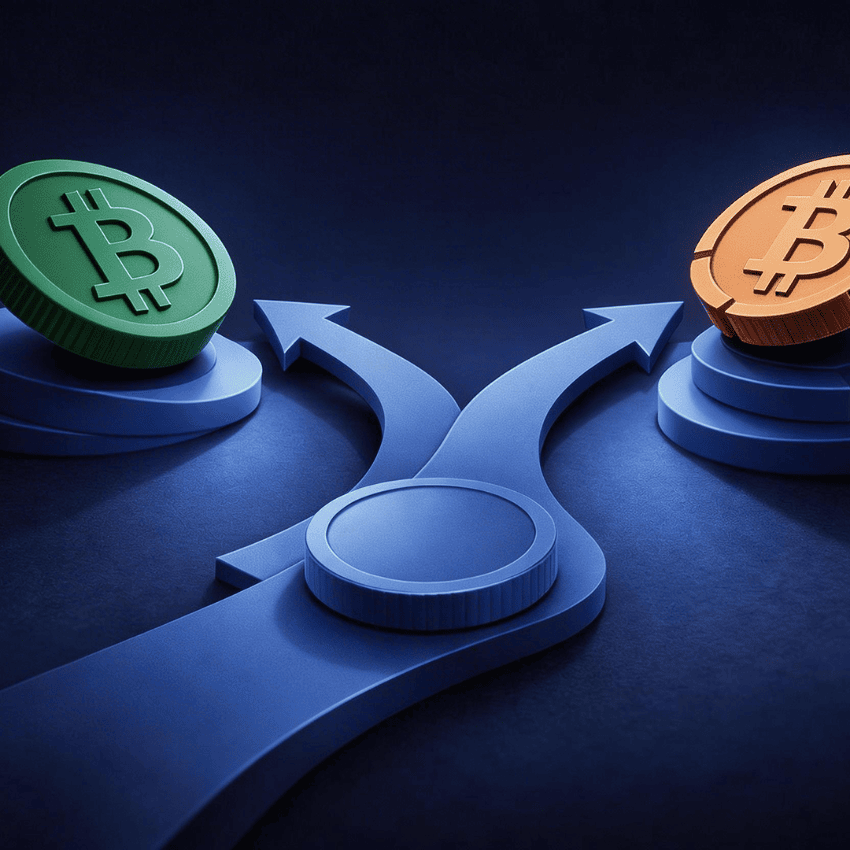
In 2017, this disagreement became permanent. Bitcoin continued on its original path, while Bitcoin Cash was created as a hard fork with larger blocks and a payments-first mindset.
The biggest technical difference lies in block size. Bitcoin limits block size to keep the network lightweight and decentralized. Bitcoin Cash increased block size to process more transactions per block.
What does that mean in practice?
Bitcoin prioritizes security, predictability, and decentralization
Bitcoin Cash prioritizes throughput, speed, and low fees
Neither approach is “right” or “wrong” — they simply optimize for different outcomes.
When the network is busy, Bitcoin fees can rise noticeably, and confirmation times may vary. This is acceptable for large transfers or long-term holding, but not ideal for small, everyday payments.
Bitcoin Cash was built to solve exactly this issue. Transactions are typically faster and cheaper, even during high usage. Fees are usually negligible, making BCH more practical for microtransactions and frequent transfers.
If the goal is buying coffee or sending small amounts quickly, BCH has a clear technical advantage.
Bitcoin has positioned itself as digital gold — scarce, secure, and resistant to change. It’s commonly used for long-term holding, hedging, and large-value transfers where security matters more than speed.
Bitcoin Cash focuses on being spendable money. Its design encourages everyday use: payments, remittances, tipping, and merchant transactions.
In short:
Bitcoin asks: How do we protect value over decades?
Bitcoin Cash asks: How do we move money efficiently today?
Bitcoin dominates institutional interest, media attention, and long-term investor confidence. It has the largest ecosystem, the highest liquidity, and the strongest brand recognition in crypto.
Bitcoin Cash, while smaller, has carved out adoption among merchants and payment-focused platforms. Its community is more niche but highly committed to the idea of peer-to-peer electronic cash.
Bitcoin leads in influence. Bitcoin Cash leads in transaction practicality.
From a trading standpoint, Bitcoin is the market anchor. It drives sentiment, sets trends, and influences the entire crypto market. Liquidity is deep, volatility is structured, and reactions to macro news are immediate.
Bitcoin Cash behaves differently. It tends to be more volatile, more reactive to ecosystem news, and more prone to sharp moves during market expansions. This makes BCH attractive for opportunistic traders, while BTC appeals to strategic positioning.
Bitcoin’s cautious development means slower innovation and limited on-chain capacity. Critics argue this reduces its usefulness for everyday payments.
Bitcoin Cash faces the opposite criticism: larger blocks can increase centralization pressure and reduce the number of participants who can run full nodes. Its smaller ecosystem also means less institutional support.
Both assets involve tradeoffs between security, decentralization, usability, and adoption.
Bitcoin makes sense if you care about long-term value preservation, market leadership, and macro relevance. It’s the asset most traders and institutions treat as crypto’s foundation.
Bitcoin Cash makes sense if you value fast, cheap payments and practical usage over ideology. It’s designed for spending, not just holding.
Some users choose one. Others use both — because they do different jobs.